
- Planning and Initiation - This is the defining stage at which the project's foundation is established.
- Define Scope & Objectives: Clearly state what the project aims to achieve (e.g., comply with a new regulation, reduce specific threats) and what systems or areas it will cover.
- Identify Stakeholders: Determine who needs to be involved, including IT, management, end-users, and compliance officers.
- Feasibility Study & Resource Allocation: Assess the project's practicality and secure the necessary budget, personnel, and tools.
- Risk Assessment (Initial): Perform an early-stage analysis to identify major security risks that the project must address.
- Analysis and Design - In this stage, the detailed requirements are gathered, and the solution architecture is designed.
- Requirements Gathering: Collect specific functional and technical requirements (e.g., must support multi-factor authentication, must integrate with existing network monitoring tools).
- Current State Analysis: Document the existing security posture, infrastructure, and policies (the "as-is" state).
- Solution Design: Develop the blueprint for the new system or process (the "to-be" state). This includes selecting technologies, defining security controls, and creating a detailed architecture.
- Policy and Procedure Development: Draft or update relevant security policies, standards, and operational procedures to support the new solution.
- Implementation and Execution - This is where the plan is put into action through configuration, installation, and deployment.
- Procurement & Setup: Purchase necessary hardware or software licenses and set up the infrastructure.
- Configuration and Testing (Internal): Install, configure, and thoroughly test the security solutions in a non-production or test environment. This ensures the controls work as designed.
- Integration: Ensure the new system integrates smoothly with the existing IT infrastructure without causing disruptions.
- Training: Train the security team, IT staff, and end-users on the new system, policies, and procedures.
- Monitoring and Optimization - The final, ongoing stage that ensures the security solution remains effective over time.
- Continuous Monitoring: Implement processes and tools (like SIEM) to continuously monitor the system for security events, incidents, and performance issues.
- Maintenance & Patching: Establish a routine schedule for system maintenance, vulnerability patching, and software updates.
- Performance Review: Regularly review the solution's effectiveness against the project's original security metrics and Key Performance Indicators (KPIs).
- Optimization/Improvement: Based on monitoring and reviews, make necessary adjustments, improvements, or upgrades to adapt to new threats and evolving business needs.
Service overview
Our mission is to empowers businesses size to thrive in an businesses ever changing marketplace. We are committed to the delivering exceptionals the value through strategic inset.
- Process-oriented implementation
- Precis workflows
- Stagged implementation
- Review results & optimizations


Key features
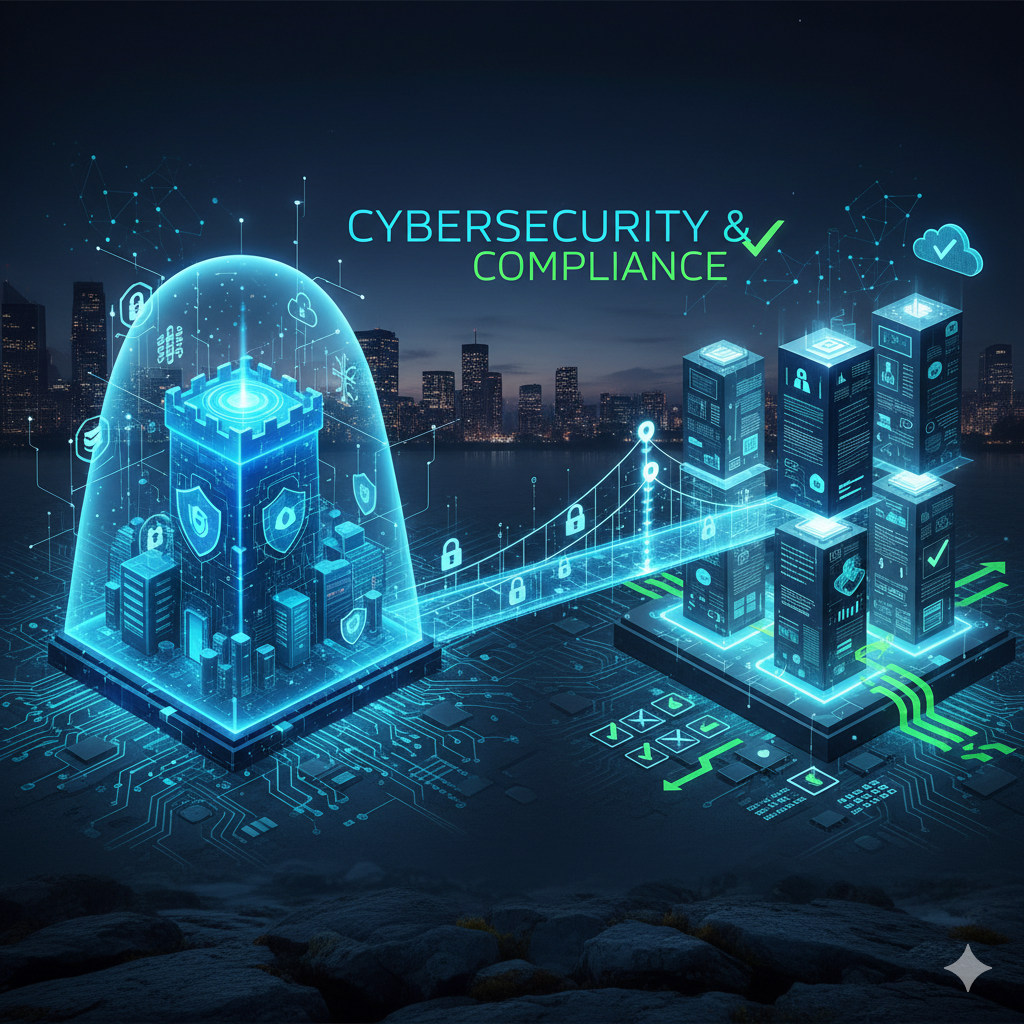
Cybersecurity focuses on implementing technical and organizational controls—like access management, data encryption, threat detection, and incident response—to ensure the Confidentiality, Integrity, and Availability of information systems and assets. Compliance, on the other hand, is the process of adhering to mandatory external regulations or internal policies, often characterized by features like regular audits, policy enforcement, risk assessments, and thorough documentation to legally and contractually demonstrate that the implemented security controls meet the required legal and industry standards.
IT Roadmap
provide strategic assistance in laying down the IT roadmap
Staged Implementations
Based on urgency & budget, the staged implementation will be done
Result-oriented
The outcome will be reviewed periodically and optimized.
FAQ
Cybersecurity is critically important for growing organizations because they are prime, yet often under-defended, targets for cybercriminals. As these organizations scale, they rapidly accumulate valuable customer data and Intellectual Property (IP).
The role of an IT consultant in cybersecurity enhancement is to act as an objective, specialized expert who assesses an organization's security posture, identifies gaps, and develops and oversees the implementation of robust defense strategies.