
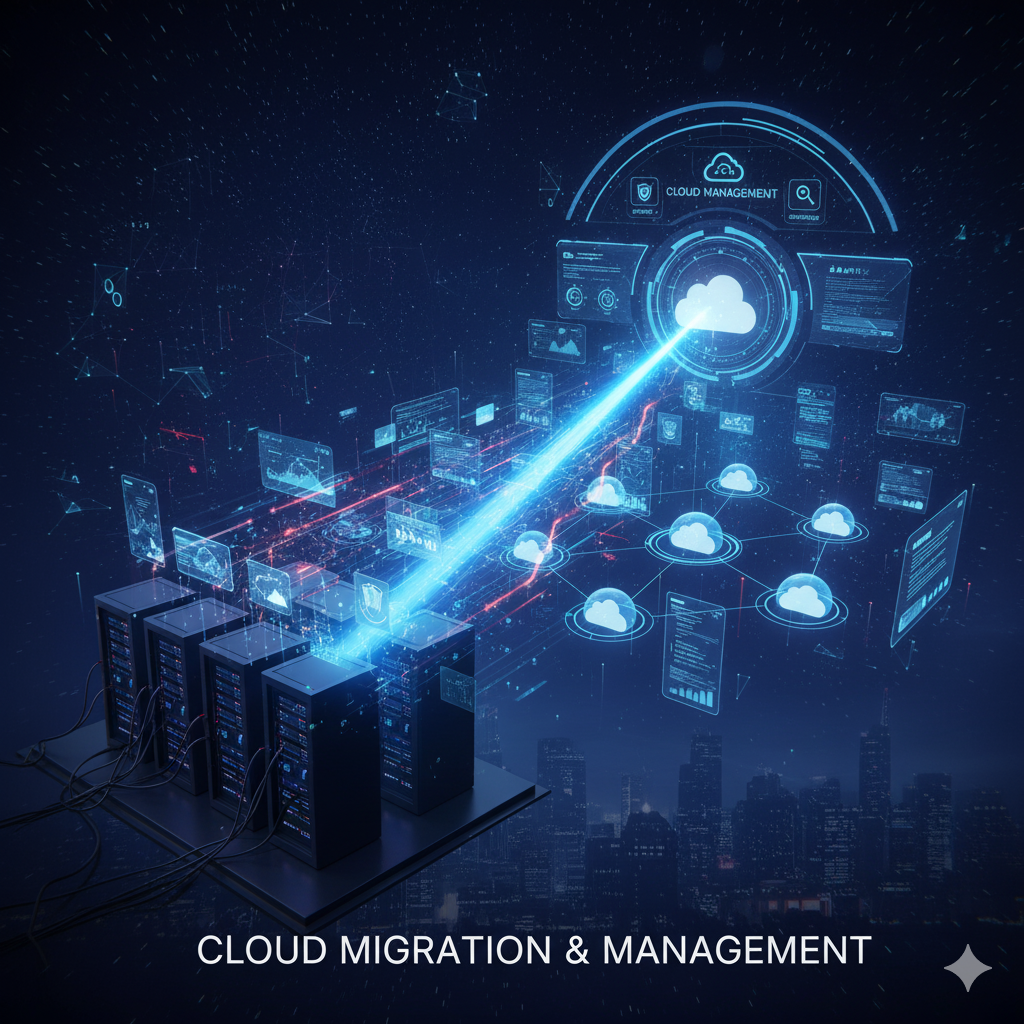
Cloud Migration is the process of moving digital assets—applications, data, IT infrastructure, and workloads—from an organization's on-premises data center (or another cloud environment) to a cloud computing environment, typically a public cloud like AWS, Azure, or Google Cloud.
- The Migration Process
- Assessment: Analyzing the existing IT environment, applications, dependencies, and business justification for the move.
- Strategy & Planning: Defining the target cloud environment, selecting a migration strategy (see below), and creating a detailed plan (e.g., timeline, resource allocation, and budget).
- Migration: Executing the move of workloads and data.
- Optimization/Modernization: Refining the architecture in the cloud to take advantage of cloud-native features, optimizing costs, and ensuring peak performance.
- Common Migration Strategies
- Rehosting: Moving an application to the cloud with minimal changes. It's the fastest and least complex option.
- Replatforming: Moving to the cloud and making minor modifications to take advantage of cloud services (e.g., replacing an on-premise database with a managed cloud database).
- Refactoring/Re-architecting: Rebuilding an application's architecture to be cloud-native, often using microservices or serverless functions to maximize cloud benefits. This is the most complex but offers the highest long-term rewards.
- Repurchasing: Switching to a new, cloud-native Software as a Service (SaaS) product (e.g., replacing an on-premise CRM system with Salesforce).
- Retaining: Keeping some applications on-premises if they are too costly or complex to migrate, or due to compliance reasons (often leading to a Hybrid Cloud model).
- Retiring: Decommissioning applications that are no longer needed.
- Cloud Management Cloud Management refers to the tools, processes, and expertise used to govern, monitor, and optimize your environment after the migration is complete. This is often called Cloud Operations or CloudOps.
- Cost Management (FinOps): Monitoring cloud spending, optimizing resource usage (right-sizing), and forecasting future costs.
- Security & Compliance: Ensuring data is protected, access is properly controlled, and industry/regulatory compliance standards (like HIPAA or GDPR) are met.
- Monitoring & Performance: : Using tools to track application and infrastructure performance, availability, and user experience.
- Automation: Using tools like Infrastructure as Code (IaC) and DevOps pipelines to automate deployment, scaling, and operational tasks.
Service overview
Our mission is to empowers businesses size to thrive in an businesses ever changing marketplace. We are committed to the delivering exceptionals the value through strategic inset.
- Process-oriented implementation
- Precis workflows
- Stagged implementation
- Review results & optimizations


Key features
Optimized Costs: Move from CapEx (upfront hardware cost) to OpEx (pay-as-you-go). Reduced infrastructure maintenance and real estate costs.
Scalability & Flexibility: Instantly scale resources up or down based on demand.
Disaster Recovery: Built-in backup and recovery systems for business continuity.
Innovation & Agility: Gain access to advanced technologies like AI, Machine Learning, and IoT. Faster time-to-market for new products and features.
Enhanced Security: Benefit from the high-level security investments and compliance expertise of major cloud providers.
IT Roadmap
provide strategic assistance in laying down the IT roadmap
Staged Implementations
Based on urgency & budget, the staged implementation will be done
Result-oriented
The outcome will be reviewed periodically and optimized.
FAQ
Cloud migration offers a growing organization significant strategic and operational advantages, primarily centered on scalability, cost optimization, and faster innovation. These benefits allow a business to handle rapid growth without the traditional constraints of physical IT infrastructure.
The role of an IT Consultant in the Cloud Migration and Management process is to act as a strategic advisor, technical architect, and project lead who guides the organization through the complex journey of digital transformation.
They bring specialized, objective expertise that internal teams may lack, helping to mitigate the risk and ensure the final cloud environment is optimized for the business's long-term goals.